
How I used ChatGPT to Build My 100-Mile Ultra Marathon Training Plan
Welcome back to the second post in this long series of how I am using AI to help me train for my next 100-mile ultramarathon – The Thames Path 100 2026. Today I’m going to talk through the prompt the I used to help ChatGPT generate a training plan for me. This is the initial foundations of “setting up” my coach so that the plan can be relevant to me.
The Big Goal
So, as already mentioned, in May 2026, I’ll be lining up for Centurion Running’s Thames Path 100: A 100-mile footrace from Richmond in London to Oxford. The race has approximately 1900 feet of elevation – so flat in comparison to other ultras on offer. The goal is simple (but not easy): finish, and ideally in under 24 hours.
To make things even more interesting…I’ll be running the London Marathon the weekend before.
Now, training for something this big isn’t just about the miles. And whilst we are a long way out from race day, I have a lot of work to do to get back into shape. Balancing family life, work, recovery, and energy levels is going to tricky. I’m fortunate I have a very understanding wife! Hiring a real coach would probably be the ideal, but the ongoing costs just aren’t realistic for me at the moment. And that’s why I decided to try something different: asking ChatGPT to become my running coach!
The Prompt That Started It All
Click to see prompt
ChatGPT, I’d like you to become my new running coach and help me create a customized training plan to run a 100-mile ultramarathon that starts on Saturday, May 2, 2026. I also have the London Marathon the weekend before.
The ultra marathon is a flat 100-miler along the Thames Path starting in Richmond, London, and finishing in Oxford with approx 1900ft of elevation over the total distance.
Below, I have added some details to guide you in designing a plan that fits around my goals, timeline, and lifestyle:
- I’m an amateur runner, not a performance athlete, but I am looking to improve.
- I work full-time, with 4 out of 5 days at home, in a desk-based job.
Format: Provide the plan as a diary with daily workouts, broken down into: – indoor workouts on a treadmill. – outdoor runs.
- In the first 2 weeks, use a reliable test to determine performance baselines. This could be conducted on either a treadmill or outside (preference with outside, though provide a treadmill alternative).
- Let me know how to provide feedback weekly so you can adapt the plan as we go.
- Present the training plan in a table format for easy reference.
- Include clear descriptions of each workout and its purpose (e.g., Endurance, speed, VO2 Max, Recovery).
- If a workout is Z2 or Z3, give me an indication as to the metrics (speed in min/mile, hard rate, or exertion level).
- As well as running sessions, I also want some Turbo Trainer and gym sessions incorporated, which will help me achieve my goals.
Goals:
- My primary running goal is to run a sub-24-hour 100-mile time.
- My secondary goal is to improve my pace over a minute per mile so that I can run faster with a lower HR.
- I want to achieve this by the date of the Ultra Marathon
Current fitness level:
- I currently run 3 times a week, mostly around 3-5 miles at a time (so max 15 miles).
- My training mainly consists of easy runs that sometimes stretch into tempo runs and 1 session a week on the treadmill for interval training.
- In addition to running, I have an indoor turbo trainer with Zwift and access to a gym that I go to approximately twice per week.
- My current easy pace is 10 min miles with an average hr of 135bpm.
Limitations:
- I can dedicate approx 1 hr per day for training (Mon-Fri) and up to 15hrs at the weekend (or longer if required).
- As mentioned, I have access to a turbo trainer and the gym
Metrics:
- I track my runs on a Coros Watch and a Coros HR monitor (arm-mounted) and load these onto Strava and the Coros Training app. I can provide access to these if required.
I included details about:
- The races (Thames Path 100 + London Marathon).
- My background (average runner, current fitness).
- My life setup (work, family, available hours).
- My training tools (treadmill, turbo trainer, gym, Strava, Coros watch, HR monitor).
- My goals (sub-24 finish, improve pace efficiency).
- Format requests (table format, workout descriptions, intensity zones, test weeks)
Why so specific? Because with AI, the quality of the output largely depends on the quality of the input. A vague “make me a 100-mile plan” would have spat out a cookie-cutter schedule (trust me, I have tried this route!). A more detailed brief gives me something I can use and also go on and tailor.
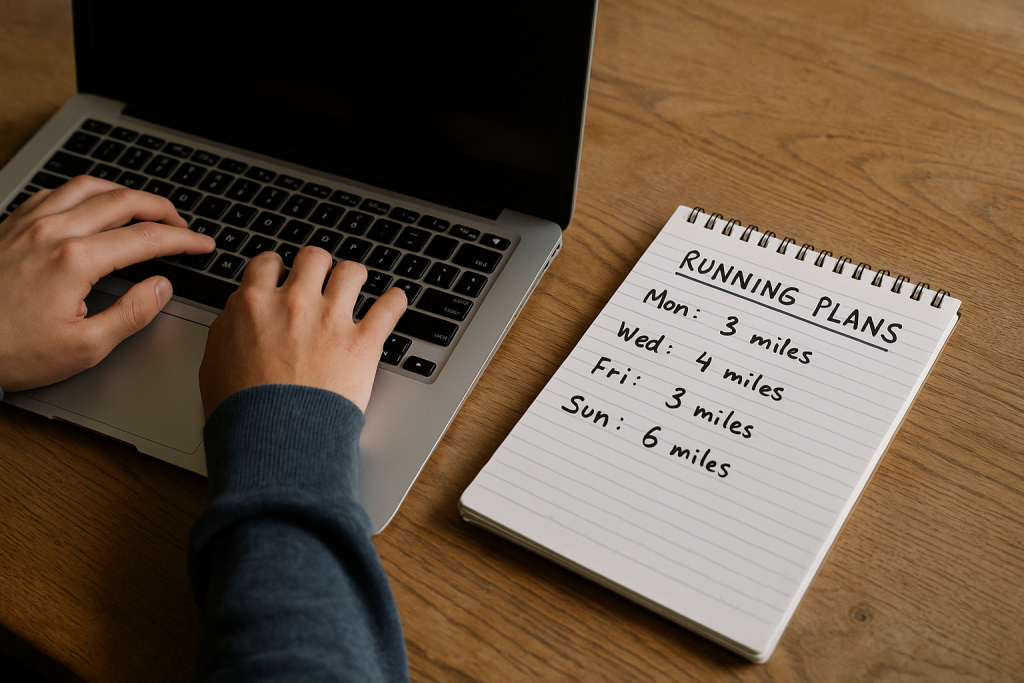
What ChatGPT generated
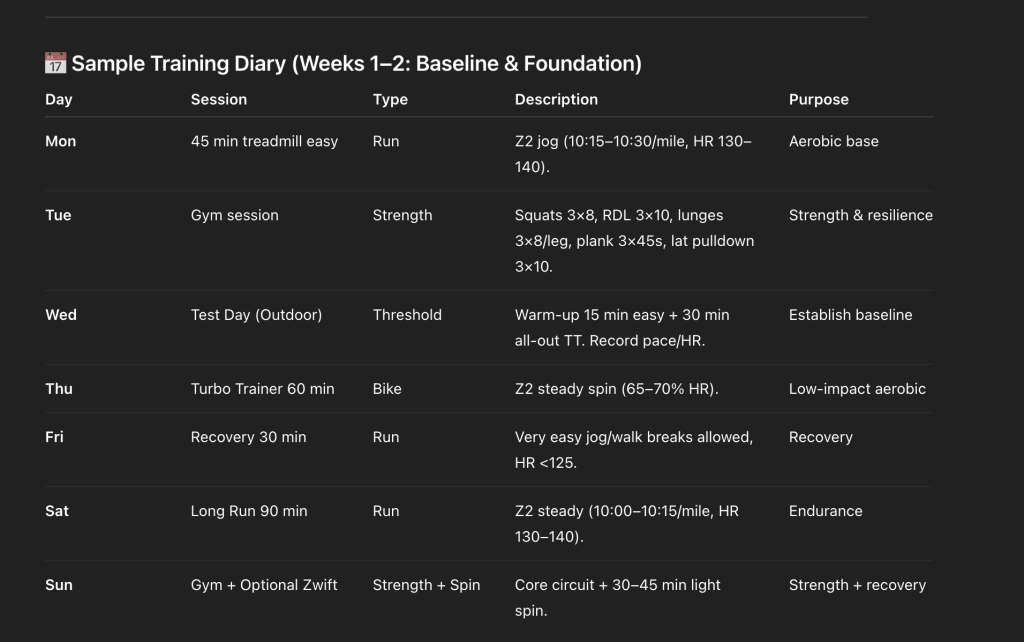
The first plan drafted by ChatGPT did surprise me a little. It wasn’t a copy-paste of miles & runs:
- It included baseline tests in the first 2 weeks.
- Runs were split between the treadmill and outdoors.
- There was a clear purpose to the session(s).
- Strength and turbo trainer sessions were added in.
- It structured long runs and drop (or lower volume) weeks, just like a real human coach would.
It’s worth noting here, though, that since the first draft was provided, I have provided additional information to improve the output and, therefore, the training I will be doing. More on that in a later post.
Why does this work for me?
The biggest advantages of taking this AI approach:
- Affordability: I can’t justify paying a coach every month. ChatGPT can be used in free mode (although I do pay for a subscription)
- Adaptability: I can feed back my data to it on a daily/weekly basis and ask it to tweak my plan.
- Breadth of knowledge: Whilst I didn’t ask it in the initial prompt, AI can pull from different training philosophies – not just one school of thought.
- Format flexibility: tables, charts, descriptions – whatever format I need to see it in, ChatGPT delivers…quickly!
Lessons Learned….So Far!
- Context, Context, Context: The more AI knows, the better the output it will give. Although this can be adapted further down the line, put in as much upfront as you can.
- Ask for structure: It’s no good just asking to “make me a plan.” Ask for test weeks, zones, and formats you want the output in.
- Feedback is key: After each session, I provide ChatGPT with the data, and it can adjust the plan as required.
- Stay human: Remember, just like your real-life coach, AI doesn’t know if you’re exhausted from life stress, over-exercising, or just having a rough day. You still need to listen to your body.
What’s coming up
Inevitably, since I gave ChatGPT the initial prompt, things have moved on, and the plan has been tweaked here and there. Over the coming weeks, I’ll share:
- How my AI-generated plan feels in practice
- The adjustments I have made due to life getting in the way, additions to the inputs I have given etc.
- The gear, nutrition, and anything else I layer on top.
Remember, though, this experiment is not about proving whether AI is the perfect coach. It’s about seeing if everyday runners – like me – can use it as a tool to chase the goals they are after.
What do you think? Can ChatGPT really coach me to finish a 100-mile ultramarathon in under 24hrs? Leave a comment and let me know!

© 2026 Alex Lee - All Rights Reserved.