
Inside the Lab: VO2 Max & Lactate Threshold Testing and What They Revealed
The Curiosity That Took Me to a Physiology Lab
My running data has always intrigued me. I’ve logged it carefully and dived into books and YouTube to learn how to train better. One lesson stood out: I needed to know my true heart-rate zones.
I had previously had VO2 Max testing completed, but to really get good data, I needed to combine VO2 Max information with Lactate Threshold data. So this meant one thing: a trip to a physiology lab at Southampton Solent University.
What the Test involved
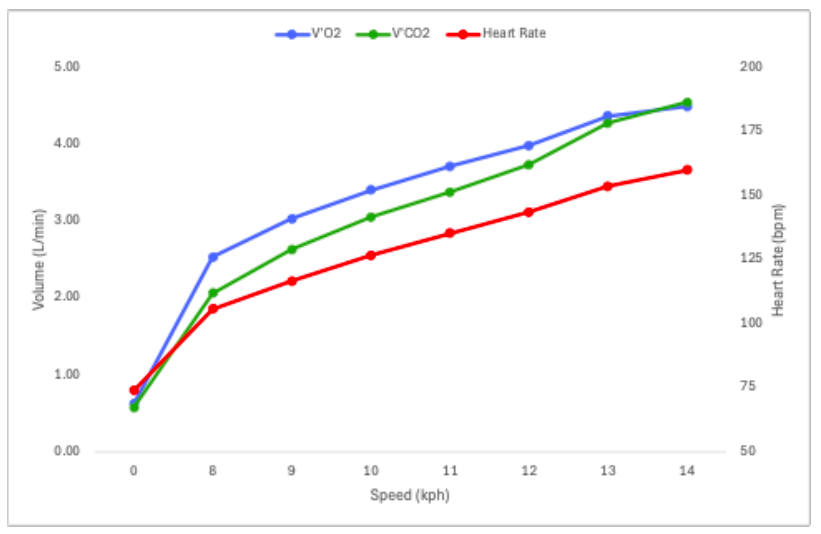
After 20 minutes of this gradual speed increase – from a warm-up at 8kph to a final push at 14kph – my legs were on fire, and the mask made for very difficult breathing. It’s a strange combination of science mixed with a dose of suffering. But the experience was well worth it as it provided additional data to put in, so that I can get more endurance out.
My Results (The Raw Truth)
This data was taken at the time of testing and not the time of writing this post.
- Body Mass: 102kg
- Height: 186cm
- VO2 max: 52ml/kg/min
- Mac HR: 165bpm
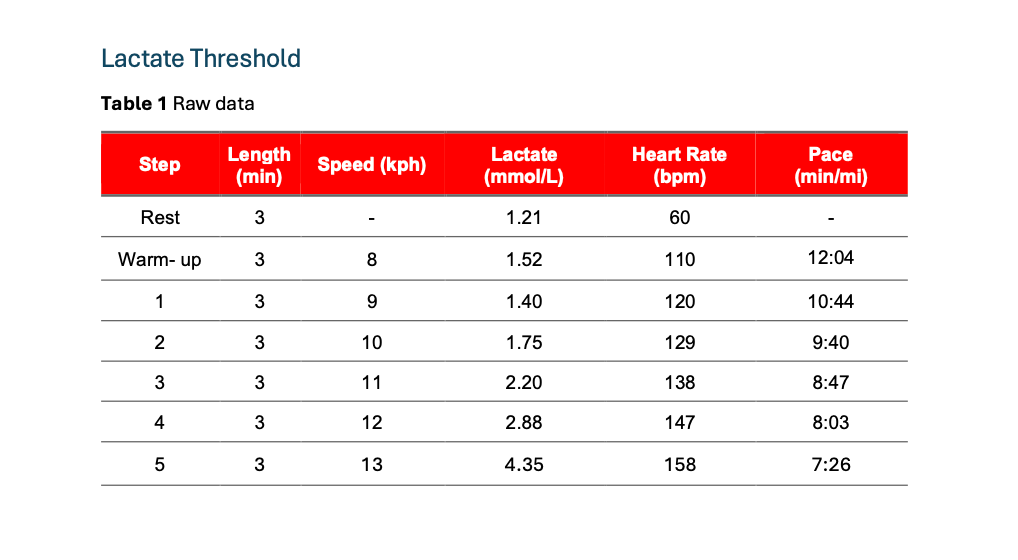
- Lactate Threshold (LT1): 122bpm @ 10:26 min/mi
- Lactate Turnpoint (LT2): 146bpm @ 8:09 min/mi
In plain English, the testing has shown that, despite not being happy with my weight or running speeds, I have a pretty solid aerobic “engine” for an amateur runner. I can sustain comfortable endurance work around 122bpm, and anything above 146bpm will inevitably become tougher the longer I try to maintain it, as my body will produce lactate quicker than I can clear it.
What the numbers mean
Many runners will talk about pace or heart rate, but lactate thresholds show where the real magic happens.
- Below LT1, your body will burn mostly fat for fuel – slow, steady, sustainable.
- Between LT1 & LT2, you’re training the engine: aerobic endurance and efficiency.
- Above LT2, you’re in the red, which is good for short bursts, but definitely bad for 24-hour races.
Why does my AI Coach care?
Until now, my AI training plan estimated zones from generic formulas. By providing real metrics, the plan becomes even more truly personalised. My AI Coach started to give me runs that had specific heart rate zones.
- Zone 1 (Recovery): < 115bpm
- Zone 2 (Aerobic base): 115 – 135bpm
- Zone 3 (Steady/Tempo): 135 – 145bpm
- Zone 4 (Threshold): 145 – 155bpm
- Zone 5 (VO2 work): > 155bpm
The Takeaway: Data Gives Direction, Not Identity
When you look just at the numbers, it’s very easy to judge yourself – “52 VO2 max? Shouldn’t that be higher?” – but data is only useful when it shapes an action. For me, that means that I will be spending more time in Zone 2 to shift my thresholds upwards, using interval training sparingly during this phase of training so that I can raise efficiency at LT2, and then letting my AI coach adapt the sessions week by week as my fitness either improves (which is what we hope will happen) or not.
What’s next?
The next step is to start combining this lab data with the metrics I get from every session from either Coros or Strava. Letting AI see the difference between the theory and the fatigue will help my plan evolve. I’ll be tracking this evolution as the months progress and sharing whether science and AI together can really build for a sub-24hr ultra runner.
© 2026 Alex Lee - All Rights Reserved.