
Training Smarter: Bringing the Uphill Athlete Philosophy to AI Coaching
The shift from “Generic” to “Guided”
The thing with AI, as mentioned in a previous post, is that the output is only as good as the input. When I first asked ChatGPT to create my plan, it did exactly what I asked for – structured, logical, progressive. However, while the plan looked solid on paper, my coach didn’t really understand ME yet.
It knew what to do and how to do it. But it didn’t know why.
It’s at this point that I wanted to change how my AI coach looked at my training. Instead of just writing a plan, I want it to coach like a human would – specifically, one that follows a certain philosophy, which was outlined in The Uphill Athlete.
Discovering The Uphill Athlete Approach
How This Approach Works For a Flat Ultra
Even I thought that using a framework for stronger mountain running for a flat ultra was slightly odd. But hear me out…the approach, when you think about it isn’t really about the terrain – it’s about efficiency of the body.
What does this mean for me though?
- Building a strong aerobic base to be able to stay in zone 2 for longer periods without fatigue.
- Controlling the intensity of the run so that I don’t burn out too early in the race.
- Developing durability by building strength and consistency rather than speed alone.
In an event like the Thames Path 100, the real battles start in the later hours of the race, when fatigue sets in. The discipline to control intensity, and output, matters more than any hill session!

“Teaching” ChatGPT
While ChatGPT can access a plethora of information, it was essential to ensure that it understood what I was truly after. So, rather than just telling it to “follow the Uphill Athlete method,” I fed it the philosophy.
I tried my best to explain what the method stands for: building a strong aerobic base through low-intensity, high-volume training, using the right metrics (Pa:HR (pace-to-heart rate) drift) to monitor efficiency. Focusing on longer-term development, balancing strength, endurance, and recovery to try and improve performance sustainably.
I was also fortunate enough to be able to feed in some recent test results from a VO2 Max & Lactate test I had conducted at Southampton Solent University, which I will go into more detail in a future post. This provided an understanding of how training intensity aligns with my zones:
- Zone 1: Recovery – easy pace below 115bpm
- Zone 2: Aerobic base – steady running around 120-135 bpm
- Zone 3: Tempo/Steady climbing pace – 135-145bpm
- Zone 4/5: Threshold and VO2 max work – short, controlled sessions above 145bpm
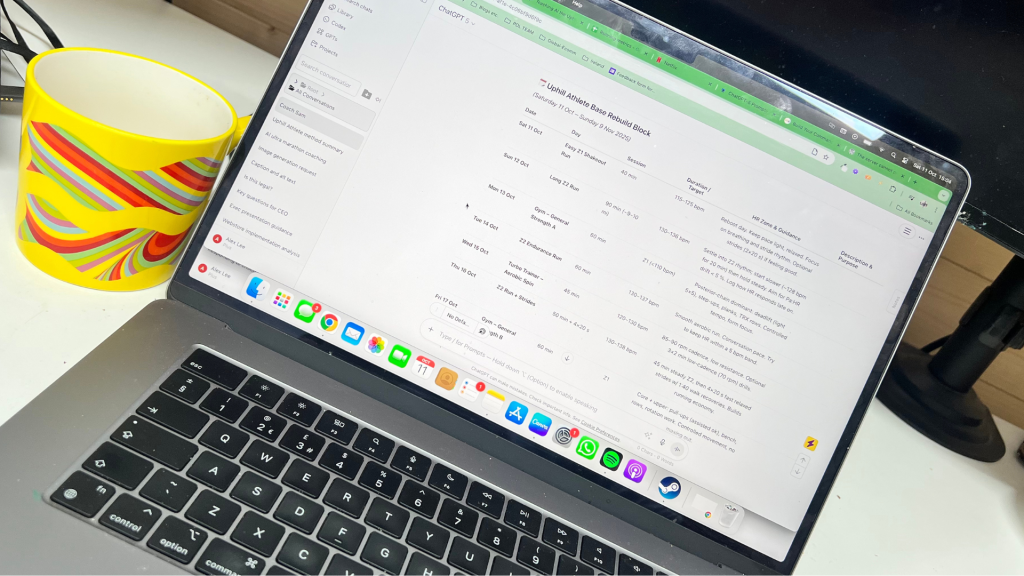
- “65-minute medium-long run. Keep HR <135bpm”
- “45-minute easy shuffle. Keep HR <130bpm; focus on relaxed cadence & form”
- “50-minute Turbo Z2 spin. HR 120-130bpm”
Instead of just prescribing workouts, it began to coach with a better purpose.
Why this matters
What’s Next?
So now I have fed my “coach” a philosophy, the next steps, as mentioned above, were to make it even smarter – by feeding in my VO2 max and lactate threshold test results. This will help AI understand my current limits and how to structure better the training intensity around real-life physiology, rather than estimating where I am.
Because if I am asking AI to “coach” me, then I may as well give it as much data as possible to do it properly.
Stay tuned – in the next post, I will share my full test results, what the test involved, how I felt during and after the test, what they mean, and how I am going to use them to shape this block of training.
© 2026 Alex Lee - All Rights Reserved.